 Ilayantech
How Much Does Custom Software Development Cost in 2027? What Drives the Price
Anyone who gives you a firm price after a five minute chat is guessing. Cost comes down to how much needs building, how complicated the rules are, and how clear you are about what you want. The good news is that you can control most of that.
If you're putting a 2027 budget together, you'll want a number for custom software development cost. Nobody enjoys hearing "it depends." But when you ask what custom software costs, it really does, so let's at least be clear about what it depends on. Once you can see the moving parts, you can have a much better conversation with anyone who's quoting you.
Why custom software development cost has no single price
Think about asking a builder what a house costs. A small two-bedroom home and a villa with a lift and a basement are both "a house." Software is the same. "A web app" might be an internal tool with three screens, or a platform with payments, user roles, reports and links to five other systems.
So when a company gives you a confident figure before asking you much, one of two things has happened. They've made a lot of assumptions, or they've left things out. Neither is good for you.
What you can get early on is a range, and a clear idea of what would push you toward the lower or higher end. That's what the rest of this guide helps you do.
What affects custom software development cost
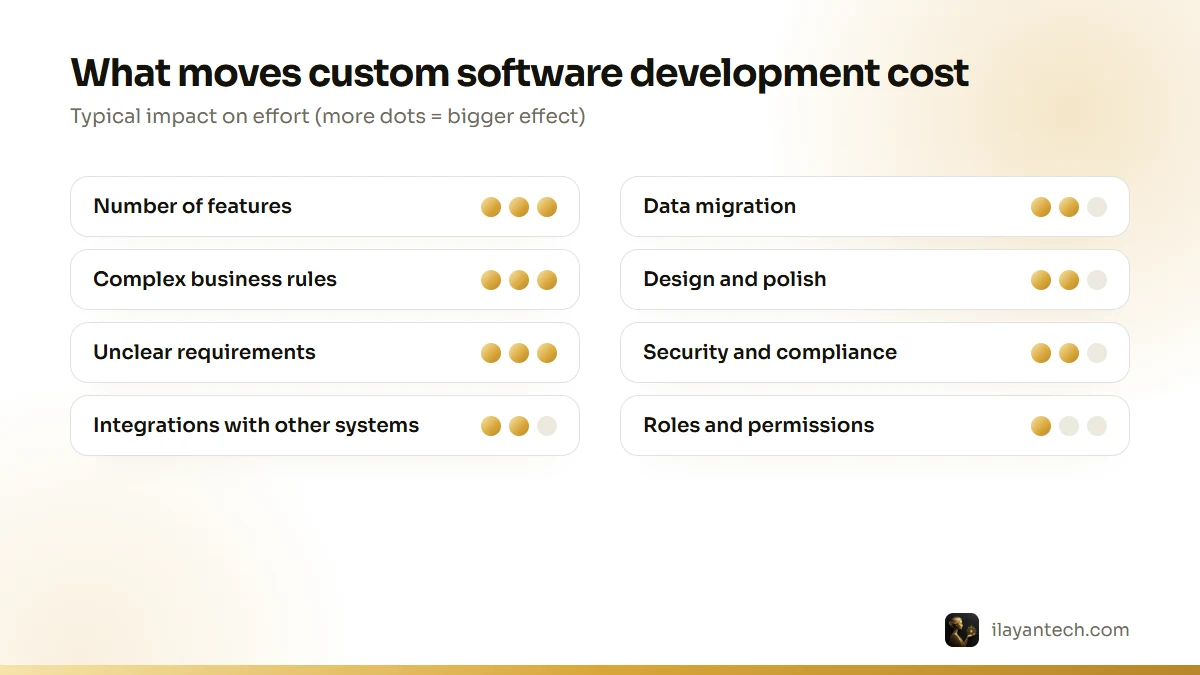
How much there is to build. Every screen, every report and every rule takes time to design, build and test. Ten features cost less than thirty. It sounds obvious, but it's the biggest factor by far.
How complicated the rules are. A form that saves a name is quick. A form that calculates tax, checks stock, applies discounts by customer type and updates three other records is not. Complexity hides in the rules, not in the number of buttons.
Connections to other systems. Payment gateways, accounting tools, messaging services, government portals. Each one has its own quirks, and you don't control them. Plan for integrations to take longer than they look.
Design effort. A tool for ten colleagues can be plain and fast. A product for thousands of customers needs more thought about how it looks and feels, and that takes real time.
Who can do what. Owners, managers, cashiers, doctors: if each sees and changes different things, that's extra logic and extra testing.
Your existing data. Moving years of customer and stock records out of spreadsheets means cleaning, matching and checking. It's rarely as quick as people hope.
The stakes. Software that handles payments or health information has to be built and tested more carefully than a simple task list.
How clear you are. This is the one people underestimate. Unclear requirements lead to rework, and rework is where budgets quietly double. A short written description of what you want, even a rough one, saves a surprising amount of money.
Three ways people pay
| Model | Works well when | Watch for |
|---|---|---|
| Fixed price | The scope is clear and stable | Changes are billed separately, so know what is included |
| Time and materials | You'll learn as you go | Ask for regular reports and a budget ceiling |
| Monthly team | You have ongoing product work | Make sure you're paying for progress, not waiting |
There's no best model. A fixed price for a clearly defined first phase, followed by something more flexible, is a common and reasonable mix.
What different kinds of projects look like
We won't put prices on these, because that would be guessing, but it helps to see where the effort goes:
| Project type | Typical shape | Where the effort goes |
|---|---|---|
| Internal tool | A few screens for your own team | Getting the rules right, importing existing data |
| Customer portal | Login, records, payments, notifications | Security, design, integrations |
| Multi-branch business platform | Billing, stock, staff, reports across sites | Many connected modules, roles and reporting |
| Marketplace or booking platform | Two or more kinds of users, payments | Complex flows, trust and safety, scale |
If your need looks like the third row, it's worth checking whether a ready-made platform covers it first. We cover that in our guide to multi-branch inventory and billing software.
The costs people forget
- Hosting and infrastructure, usually a monthly or yearly fee that grows with usage.
- Third-party services: payment gateways, SMS or WhatsApp messaging, email sending, maps. Many charge per use.
- Data migration, which often takes longer than building the screens.
- Training and rollout, so your team actually uses the thing.
- Maintenance: security updates, bug fixes, small changes.
- Future features. If it's useful, people will ask for more.
Software isn't finished when it goes live. Treat upkeep as a normal ongoing cost from the first day, and ask any provider how they handle it. The honest ones will have a straight answer.
How to keep the cost sensible
Start with the smallest version that solves a real problem. Release it. Then improve it based on what people actually do, not what everyone guessed in a meeting. It's cheaper to learn early.
Decide quickly, too. A team that waits three days for every answer is a team that's billing you for waiting. And don't build what you can buy: for standard things like sending emails or taking card payments, use a proven service. If you're not sure where that line sits, read our piece on custom software vs off-the-shelf software.
Finally, put the exciting but non-essential ideas into a "phase two" list. They're not lost, they're just not blocking launch.
How to read a quote
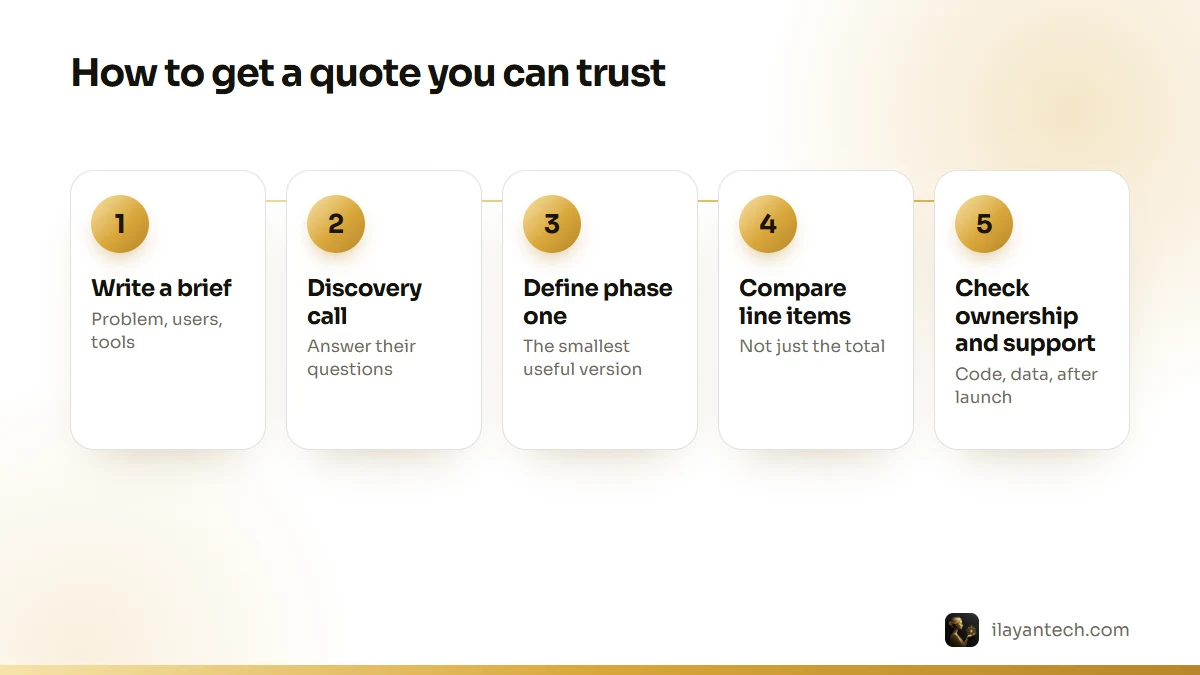
When you get a quote, check for the following before you look at the total:
- What's included: design, building, testing, setting up hosting, documentation, training
- What isn't, and what would cause extra charges
- How changes are handled
- A breakdown by phase or feature, not just one big number
- Who owns the code and the data at the end
- What support costs after launch
A price that's far below every other quote, with no explanation, is more often a warning than a bargain. And a company that won't put the scope in writing is telling you something. For more on judging who you're dealing with, see how to choose a software development company.
Planning your 2027 budget
If you're deciding how much to set aside, think in three parts rather than one number:
- The build: your first version, ideally small and focused.
- The running costs: hosting, services and support, every month or year.
- The growth: improvements you'll want once people start using it.
Many teams also keep some room for changes, because requirements shift once real users get involved. And before you commit to a big budget, look at how a web application project actually unfolds, so you know which stage your money is going into.
Questions to ask about price
- What exactly does this price include and exclude?
- How do you handle changes, and how do you price them?
- What will it cost per month to run and support after launch?
- Can we split the work into phases and pay as we go?
- Who owns the code and data when the project ends?
If you'd like a realistic range for your own idea, tell us what you're trying to build. We'll ask a few questions first, because that's the only way to give you a number worth trusting.
Frequently asked questions
Why do custom software quotes vary so much between companies?
Because they are often quoting for different things. One might include design, testing, hosting setup and support. Another might cover only the coding. Ask each company to list exactly what is in the price and what is not, and the gaps usually explain themselves.
Is a fixed price better than paying by the hour?
Fixed price works well when the scope is clear and unlikely to change. Hourly or monthly billing works better when you expect to learn as you go. Many teams agree a fixed price for a well-defined first phase and then switch to a flexible arrangement.
Can I start with a small budget?
Yes, and we would usually suggest it. One focused tool that solves one real problem is a much better first step than a big plan. It lets you see real use before you invest more.
What do I keep paying for after launch?
Hosting, security updates, fixing bugs, support, and any new features you ask for. It is a normal, ongoing part of owning software, so ask every provider how they price it before you sign.
Is it cheaper to hire freelancers than a software company?
Sometimes the hourly rate is lower, but cost is not just the rate. Consider who handles design, testing and project management, what happens if one person disappears, and who maintains it after launch. For a small, well-defined job a freelancer can be great. For something you will rely on for years, a team often costs less in the long run.